

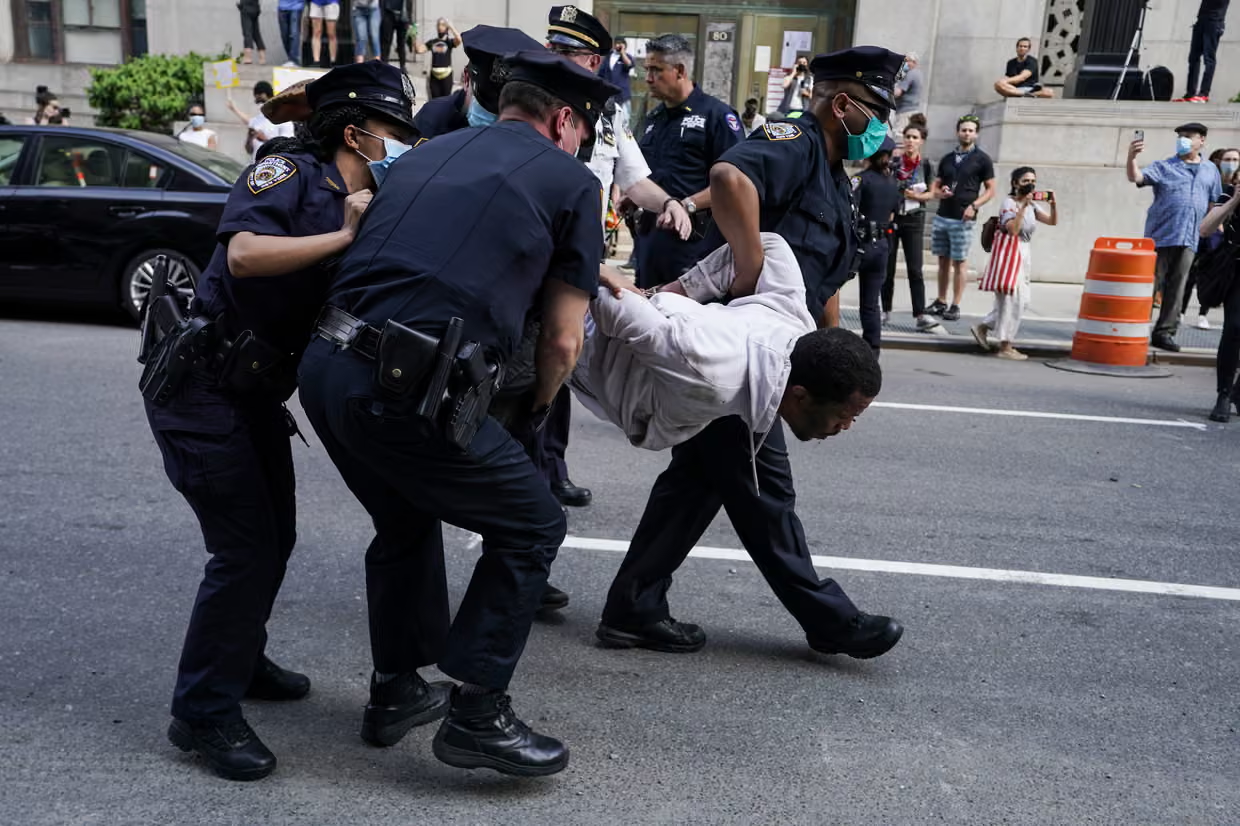
A bad police encounter can change a person’s life before anyone has time to understand what happened. Police Brutality becomes more than a headline when an officer’s force, arrest, search, or detention crosses the line from lawful authority into a violation of someone’s constitutional rights. In the United States, that line matters because civil court may offer a path to money damages, policy changes, and public accountability when internal complaints go nowhere.
These cases are not simple anger turned into paperwork. They depend on evidence, deadlines, legal standards, and the hard question of whether an officer acted “under color of law” while depriving someone of rights protected by federal law. A strong lawsuit often starts with details that feel small at first: body-camera gaps, medical records, witness names, dispatch logs, jail intake notes, and the exact words spoken during the stop. For readers tracking legal accountability, public reporting, and civic issues, civil rights legal coverage can help place these cases in a broader national context.
How Police Brutality Civil Rights Lawsuits Begin
The first stage of a civil rights case often looks less dramatic than people expect. Before a complaint reaches a federal courthouse, someone has to turn a painful event into a timeline that a judge, lawyer, insurer, city attorney, or jury can understand. That means emotion matters, but proof carries the weight.
What Counts as Police Misconduct in a Civil Case?
Police misconduct in a civil lawsuit usually involves more than rude behavior or poor judgment. A case becomes serious when an officer’s conduct may have violated the Fourth, Eighth, or Fourteenth Amendment, depending on whether the person was stopped, arrested, detained, jailed, or already convicted. The federal civil rights statute often used in these cases is 42 U.S.C. § 1983, which allows lawsuits when someone acting under state authority causes a deprivation of federal rights.
A typical excessive force claim may come from a traffic stop where a person is already handcuffed, not resisting, and still gets slammed to the ground. A false arrest claim may start when an officer lacks probable cause but takes someone to jail anyway. A wrongful jail injury case may involve ignored medical distress, unsafe restraint, or deliberate refusal to protect a detainee.
The mistake many people make is thinking the case turns on whether the officer was “mean” or “unfair.” Courts usually ask a colder question: did the officer’s conduct violate a clearly protected legal right under the facts as they existed at that moment?
Why the First Days After the Incident Matter
The first few days after the encounter can shape the entire case. Medical care creates records. Photos preserve bruising before it fades. Witnesses remember details before time sands down the edges. A written personal account helps lock in the sequence before stress, fear, and outside opinions start changing how the story is told.
This is also when evidence can disappear. Surveillance video may be overwritten. Body-camera footage may sit behind a public records process. Jail calls, dispatch audio, and incident reports may not be easy to obtain without formal requests or litigation tools. A person who waits too long may still have a valid claim, but the proof may be weaker than the truth.
A counterintuitive point matters here: the cleanest cases are not always the most violent ones. Sometimes the strongest case is the one with plain video, clear medical records, and an officer report that conflicts with both. A smaller injury with stronger proof can travel farther than a severe injury wrapped in missing facts.
The Legal Standards That Shape Excessive Force Claims
A civil rights lawsuit does not ask whether an officer could have handled things better in hindsight. It asks whether the conduct crossed a legal boundary. That difference frustrates many people, but it is the center of the case.
How Courts Look at Excessive Force Claims
Excessive force claims usually turn on reasonableness. Courts look at the facts from the perspective of an officer at the scene, not from the calm comfort of a living room months later. That can make these cases hard, because judges often give officers room to make fast decisions during uncertain encounters.
Still, that room is not unlimited. Force used against a person who is fleeing, armed, actively fighting, or threatening someone will be judged differently from force used against someone restrained, injured, compliant, or confused. The same punch, taser use, knee strike, or takedown can look different depending on the seconds before it happened.
Real cases often come down to physical positioning. Was the person on the ground? Were their hands visible? Was the officer alone? Were other officers already controlling the person? Did the threat end before force continued? These details are not decoration. They are the spine of the claim.
Why Qualified Immunity Can Block a Case
Qualified immunity is one of the biggest barriers in police misconduct cases. It can protect government officials from liability unless they violated a clearly established legal right. Cornell’s legal overview describes the doctrine as protection for officials unless the right at issue was clearly established under statutory or constitutional law.
This means a plaintiff may show that something wrong happened and still lose if the court decides prior case law did not give the officer fair warning. That is the part many Americans find hardest to accept. The case may fail not because the injury was minor, but because the legal match was not close enough.
The unexpected truth is that civil rights lawsuits are often battles over comparisons. Lawyers search for earlier decisions with similar facts: same type of force, same level of resistance, same stage of arrest, same warning signs. A case can rise or fall on whether another court already drew the line in a similar situation.
Evidence, Damages, and the Role of the City
A lawsuit against an officer can become a case about a police department, a city budget, and a local culture of discipline. That shift does not happen automatically. The plaintiff has to connect the individual incident to a larger legal theory that courts recognize.
What Evidence Can Prove a Civil Rights Violation?
Strong evidence usually comes from more than one source. Body-camera footage helps, but it may not show everything. A bystander video may catch the angle the officer’s camera missed. Medical records can show injury patterns. Dispatch logs can show what officers knew before arrival. Internal complaints may show whether similar conduct happened before.
Witness testimony also matters, but it can be fragile. People move, forget, fear involvement, or remember events differently. That is why lawyers often want names, phone numbers, photos, store camera locations, license plates, and social media posts as early as possible.
A careful plaintiff also saves the less obvious records. Missed work, therapy visits, medication receipts, torn clothing, phone damage, booking paperwork, and follow-up medical bills can all help show the effect of the incident. A lawsuit is not only about proving the officer crossed a line. It is also about proving what that line crossing cost.
When a City or Department May Be Part of the Case
A city is not automatically liable because it employs the officer. Under federal civil rights law, municipal liability usually requires proof that a policy, custom, failure to train, or failure to supervise caused the violation. That is a higher bar than many people expect.
A pattern can matter. Prior complaints, repeated uses of force, weak discipline, ignored warning signs, or training gaps may support the argument that the problem was not one bad moment. The Department of Justice also investigates some law enforcement misconduct, including excessive force, sexual misconduct, theft, false arrest, and deliberate indifference to serious medical needs.
This is where a case can move from personal injury into public accountability. A single lawsuit may expose how a department reviews force, tracks complaints, disciplines officers, or trains supervisors. Money damages may help one person, but policy discovery can show whether the same risk sits waiting for the next driver, protester, tenant, teenager, or parent.
Settlements, Trials, and What Victims Should Expect
Most people want a clear ending. They want the officer punished, the department exposed, and the harm recognized. Civil court can sometimes deliver part of that, but it works through its own narrow tools.
Why Many Police Misconduct Cases Settle
Many police misconduct cases settle because trials are expensive, uncertain, and emotionally draining. A city may deny wrongdoing while still paying money to avoid risk. A plaintiff may accept a settlement because it gives control and closure without years of appeals.
Settlement does not always mean the case was weak. It may mean both sides saw danger. Video may look bad for the officer, but qualified immunity may still create risk for the plaintiff. Medical injuries may be clear, but a jury may split over whether the person resisted. Litigation often rewards practical decisions more than perfect moral satisfaction.
The hard part is that settlement language can feel cold. A city may refuse to admit fault. The officer may keep working. The agreement may include confidentiality or limits on public statements. That can feel like a second insult, but a well-negotiated settlement can still pay medical bills, lost income, emotional harm, attorney fees, and sometimes push quiet changes inside the department.
What Trial Looks Like in a Civil Rights Case
Trial turns a personal experience into evidence. The plaintiff may testify about fear, pain, humiliation, injury, and the life after the incident. Officers testify about perceived threats, training, commands, and split-second choices. Experts may explain police practices, medical injuries, use-of-force standards, or department policy.
Jurors often bring mixed feelings into the courtroom. Some distrust police. Some strongly support them. Some want to believe both sides until the evidence forces a decision. That makes storytelling important, but not in a theatrical way. The best trial story is usually simple: here is what happened, here is what the officer knew, here is why the force or arrest crossed the legal line, and here is what it cost.
Police Brutality cases can also lead to appeals, especially when qualified immunity appears early. A plaintiff may win one stage and lose another. A city may settle after losing a key motion. An officer may be dismissed while municipal claims continue. The path is rarely straight, and anyone entering it should know that endurance can matter almost as much as outrage.
Choosing the Right Next Step After an Incident
The smartest response after a harmful police encounter is not panic, revenge, or public posting before evidence is secured. It is documentation. A person should write down the timeline, save every record, get medical care, identify witnesses, preserve photos and video, and speak with a civil rights lawyer before deadlines close.
A DOJ complaint can be useful in some situations, especially when the issue suggests broader civil rights concerns. The Department of Justice provides a public civil rights complaint portal, though submitting a complaint is not the same thing as filing a private lawsuit for damages.
Police Brutality lawsuits work best when anger is converted into proof. The law may feel slow, technical, and unfairly narrow, but it still gives Americans a way to challenge abuse under color of authority. Do not rely on memory alone, and do not assume the truth will speak for itself. Build the record, protect the deadline, and get advice from someone who understands how civil rights cases are actually fought.
Frequently Asked Questions
What is a police brutality civil rights lawsuit?
It is a civil case claiming that an officer, while acting under government authority, violated someone’s constitutional or federal rights. These lawsuits may seek money damages, attorney fees, and sometimes changes tied to department policy or training.
Can I sue police for excessive force after an arrest?
Yes, but the case depends on the facts. Courts look at the threat level, resistance, officer commands, injuries, and whether the force continued after control was gained. Video, medical records, and witness statements can make the claim stronger.
How long do I have to file a police misconduct lawsuit?
Deadlines vary by state and claim type. Some cases also require quick notices before suing a city or county. Waiting can damage the case, even if the legal deadline has not expired, because video and witness evidence may disappear.
What evidence helps prove police brutality in court?
Useful evidence may include body-camera footage, bystander video, medical records, photos, officer reports, dispatch logs, jail records, witness statements, and proof of lost income. The best evidence usually confirms both what happened and how it affected your life.
Does qualified immunity mean police cannot be sued?
No. Qualified immunity can block some claims, but it does not prevent every lawsuit. A case may proceed when the officer violated a clearly established right under facts close enough to prior legal decisions.
Can a city be liable for police misconduct?
A city may be liable when a policy, custom, training failure, supervision failure, or repeated ignored misconduct caused the rights violation. The city is not automatically responsible only because the officer worked for the department.
Do police brutality cases usually go to trial?
Many settle before trial because both sides face risk, cost, and uncertainty. Settlement may happen without an admission of wrongdoing. Trial becomes more likely when the facts, damages, or public accountability issues remain sharply disputed.
Should I file a complaint before suing the police?
An internal complaint or DOJ report may help create a record, but it is not always required for a private lawsuit. Speak with a civil rights lawyer first when possible, because statements made in a complaint may later affect the case.